Mechanical Engineering
During the course, students receive wide spectrum engineering training which allows them to complete the solid scientific preparation acquired in understanding, definition, modelling and solution of problems, including complex ones, typical of industrial engineering.
Double Degree - Georgia Institute of Technology
Request information about the degree program

Explore

Type Programme
Master's Degree

Type of admission
Free access course

Didactic method
In-person programme

Language
Italian

University site
Brescia

Department
Department of Mechanical and Industrial Engineering

Degree identification category
LM-33 Mechanical Engineering
Study Plan
The Second Cycle degree in Mechanical Engineering sets out the acquisition of 120 university credits. There are 5 curricula offered.
Useful links
The objective of the degree program is to train engineers who, with a solid understanding of mechanical engineering topics, are capable of tackling highly complex problems by gaining an in-depth understanding of their underlying phenomena and utilizing advanced tools—both conceptual and operational—to address them. In particular, the program addresses cross-disciplinary topics related to design, representation and modeling methods, the functional and structural design of components and systems, control and measurement systems, thermal, thermodynamic, and thermofluid dynamic design of machines and plants, and the design, control, and management of the production cycle and related equipment and facilities. Furthermore, the professional profile is enhanced through training activities geared toward entering the workforce, such as internships, apprenticeships, and laboratory and design projects.
The degree program is divided into five tracks, which allow students to develop more specific skills in areas of particular interest within mechanical engineering:
Automotive Track
This track aims to train engineers capable of designing and sizing key components and systems of the chassis and powertrain, as well as tuning the vehicle’s dynamic behavior using professional software, with particular emphasis on active safety and human-vehicle interaction. It also describes and explores in depth the methodologies for conducting testing campaigns in the laboratory, on public roads, and on test tracks, including for sports cars and special applications. The program is complemented by courses on innovative propulsion technologies—such as hybrid, electric, and fuel cell systems—as well as on onboard electronic systems.
Biomechanics Curriculum
This program aims to supplement the foundational training of the Master’s program in Mechanical Engineering with more specialized skills focused on the design of systems and devices for the biomedical sector. To this end, alongside the traditional courses in the Mechanical Engineering program, instruction is provided (mostly in English) on topics such as the fluid dynamics of biological systems, the schematization and functional and structural simulation of apparatus and systems, the behavior of materials and biomaterials used in biomedical applications, prototyping and manufacturing technologies for prostheses and devices, sensors for biomedical use, as well as procedures for quality management and the safety of biomedical products.
Curriculum in Mechanical Design
This track aims to develop specialized skills for the design of mechanical components, structures, and systems. To this end, the program provides in-depth knowledge of traditional and advanced design methodologies (e.g., fracture mechanics), analytical and numerical structural analysis tools (FEM, finite differences, etc.), the behavior and strength of both traditional and innovative materials under various operating conditions, and experimental methodologies for their mechanical characterization. These skills are complemented by knowledge of drive systems and issues related to ergonomics and safety.
Energy Transition Curriculum
This program aims to train engineers with expertise in energy conversion processes, with a particular focus on technologies geared toward decarbonization (including renewable energy and mobility) and energy efficiency. Given the highly interdisciplinary nature of the topics, throughout the program students also acquire skills in the field of computational thermofluid dynamics and in the use of modern computational tools for process optimization and decision support—tools that are indispensable for addressing the design and management of procedures (not only technological ones) that are inherently complex and innovative. With regard to the traditional aspects typical of mechanical engineering education, the program also covers mechanical design and fluid dynamics techniques, as well as the management of industrial plants.
Production Curriculum
Addresses issues related to basic and advanced design criteria, the control and management of production systems, the design and engineering of parts to be manufactured, the optimization of the production cycle, traditional and innovative production techniques, methods and tools for production control and management, software for simulating plastic deformation (FEM), plant management and operation software, software for quality analysis and assessment, and design software (CAD and CAM).
Students select their curriculum upon enrollment in the degree program. The degree program spans 2 years and requires the completion of a total of 120 CFU, divided into core, related, or supplementary courses and elective courses chosen by the student, in addition to activities related to preparing for the final exam and acquiring further knowledge useful for entering the workforce.
Some of these courses may optionally be taken as part of international exchange programs at partner universities abroad.
Mechanical Engineer
Role in a Work Environment
Graduates with a master’s degree in Mechanical Engineering possess in-depth interdisciplinary training that qualifies them to perform a wide range of functions within various types of companies in the manufacturing and process industries, including coordinating work teams and liaising with development and expertise centers, as well as with professionals from diverse backgrounds, such as those in sales. Typical roles include mechanical designer, head of the technical department or research and development center, and manager of production and plant maintenance.
Skills
Graduates with a master’s degree in Mechanical Engineering possess in-depth knowledge and skills in the field of mechanical engineering, demonstrating a thorough understanding of its underlying phenomena and utilizing advanced tools—both conceptual and operational—to address them; They are able to critically analyze experimental data, competently interpret the results of analytical and numerical models, seek innovative technical and design solutions, and engage with international technical literature. All of this enables them to carry out and coordinate the design of mechanical components and even complex operating machines; to design, optimize, and manage machines and plants for energy production; and to design, control, and manage production processes, equipment, and plants. Their education is enriched and complemented by the proposed curricula, which enable them to acquire specific professional knowledge and skills in the fields of automotive mechanics; structural design of mechanical components and systems; design of biomedical devices; thermal, thermohydraulic, and thermofluid dynamics design of machines and plants; and the design, control, and management of the production cycle and related equipment and plants. In general, graduates with a master’s degree in Mechanical Engineering possess the ability to effectively communicate information, data, and solutions in Italian and at least one other European Union language to both specialists and non-specialists, as well as the ability to independently expand and deepen their knowledge, skills, and competencies to ensure effective professional development throughout their careers.
Career Opportunities
Graduates with a master’s degree in Mechanical Engineering can find employment at various types of companies engaged in manufacturing, processing, and services: in particular, companies in the metalworking sector that design and produce machinery and mechanical equipment, motor vehicles and other means of transportation, and biomedical devices and components; steel, metallurgical, and chemical industries; companies that produce, supply, or distribute energy; and companies that install, test, maintain, or manage plants, machinery, and production departments. In addition to roles in manufacturing and service industries, graduates with a master’s degree may find employment at engineering firms, in public administrations and local government agencies, and at research institutions. They may also pursue further studies in second-level master’s programs and/or doctoral programs. They may take the professional qualification exam to be registered in the industrial section of the engineers’ professional registry.
The degree program aims to train professionals with a solid background in mechanical engineering, capable of conceiving, planning, designing, manufacturing, and managing products, processes, components, systems, capital goods, facilities, and services. There is strong demand for such professionals in the region, which has a distinctly industrial character and requires highly qualified personnel to manage the technological innovation driven by the growing complexity of the production system.
To meet these needs, students must acquire:
• the ability to tackle highly complex problems in the field of mechanical engineering, gaining an in-depth understanding of their underlying phenomena and knowing how to schematize, model, and solve them, including through an interdisciplinary approach;
• more specifically, the ability to correctly apply methodologies and techniques for the design and verification of machines, components, and mechanical systems; to plan, design, and manage highly complex experiments and tests on machines, components, and mechanical systems, critically evaluating the results; to use theoretical models and specialized software to solve mechanical engineering problems and to interpret the results competently; to seek innovative technical and design solutions, and to manage the research and development of products and systems;
• the ability to independently expand and deepen one’s knowledge, competencies, and skills for the purpose of effective professional development throughout one’s career;
• the ability to effectively communicate information, data, and solutions in Italian and English—both in writing and orally—to specialists and non-specialists alike, and to engage with international technical literature;
• the ability to interact with interdisciplinary work groups, through knowledge of the various technical-scientific and regulatory tools and languages of the field, as well as communication methods.
The program enables students to achieve these objectives by first and foremost providing them with a solid foundation in the core subjects of mechanical engineering, particularly with regard to energy machines and systems, measurement, conceptual, functional, and structural design, representation techniques, production technologies and systems, and industrial and mechanical plants. This foundation, acquired primarily during the first year of the program and supplemented with knowledge of economics and business, is further developed and applied through the various tracks into which the degree program is organized, each offering more specialized training focused on specific areas of interest within mechanical engineering. Of particular importance in this regard are related and supplementary activities, as well as various activities designed to facilitate entry into the workforce—mostly laboratory-based and application-oriented—along with those chosen independently by the student, the latter typically taking place during the second year of the program.
The topics covered in the degree program’s curriculum are as follows:
• Automotive mechanics, specifically the study of a vehicle’s dynamic behavior—including through the use of professional software and simulators—and the analysis and design of key chassis and powertrain components and systems, with particular emphasis on active safety and human-vehicle interaction. The curriculum also describes and explores in depth methodologies for planning and managing testing campaigns in the laboratory, on the road, and on the track, including for sports cars and special applications. The program is rounded out by courses on innovative propulsion technologies—such as hybrid, electric, and fuel cell systems—as well as on onboard electronic systems.
• the design of systems and devices for the biomedical sector. To this end, through coursework—most of which is taught in English—students enhance their training with knowledge and skills related to the fluid dynamics of biological systems, the schematization and functional and structural simulation of apparatus and systems, biomechanics, the behavior of materials and biomaterials used in biomedical applications, prototyping and manufacturing technologies for prosthetics and devices, sensors for biomedical use, as well as procedures for managing the quality and safety of biomedical products.
• The advanced and innovative design of mechanical components, structures, and systems. To this end, the design knowledge and skills common to all curricula are supplemented by more specialized training in advanced design methodologies and the related tools for structural analysis, including both analytical methods (e.g., fracture mechanics, plate theory, theory of large-curvature solids, etc.) and numerical methods (FEM, finite differences, etc.), on the behavior and strength of materials under various operating conditions—including both traditional and innovative materials (e.g., composites, materials produced by additive manufacturing, etc.)—and on experimental methodologies for their mechanical characterization. These topics are complemented by training on drive and control systems and on issues related to ergonomics and safety.
• the energy transition and related energy conversion processes, with particular emphasis on technologies aimed at decarbonization and energy efficiency. Given the highly interdisciplinary nature of the topics, throughout the program students also acquire knowledge and skills in the field of computational thermo-fluid dynamics and in the use of modern computational tools for process optimization and decision support—tools that are indispensable for tackling the design and management of procedures that are inherently complex and innovative. Attention is also given to mechanical and fluid dynamics design techniques and the management of industrial plants.
• the design and optimization of production processes and industrial plants, as well as the development of new products through the use of innovative technologies and specialized software. In particular, students address issues related to traditional and advanced criteria for the design, control, and management of production systems; the design and engineering of parts to be manufactured; the fine-tuning of the production cycle; traditional and innovative production techniques; and the methods and tools for production control and management. To this end, the program utilizes simulation software for plastic deformation manufacturing processes (FEM), plant management and operation software, quality analysis software, and design software (CAD and CAM).
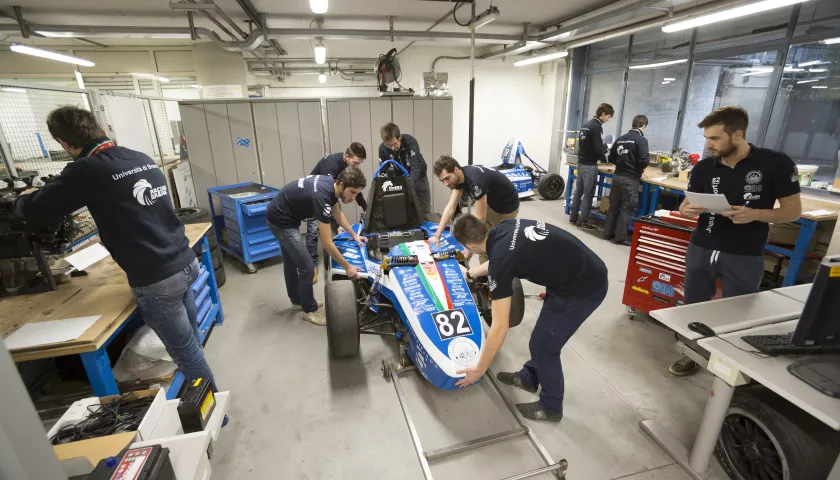
The training is delivered through a variety of methods, also aimed at acquiring and enhancing soft skills. In particular, alongside traditional lectures and exercises in which students participate by independently processing the theoretical content and practical applications, the training program includes various laboratory activities that are particularly useful for entering the workforce, during which students are given the opportunity to interact directly with professional-grade tools, equipment, and software, and their teamwork is fostered through the development and presentation of design solutions based on assigned specifications. Several courses in the program also include seminars and company visits, which, through representative case studies, allow students to gain insight into the challenges and dynamics of the professional world, as well as to engage with industry professionals. These types of experiences can be further explored in the final phase of the program through participation in internships at local companies or in university-based project activities.
The acquisition of disciplinary terminology and the ability to communicate effectively in English are fostered both by courses (required and elective) taught in English and by the use of English-language textbooks and teaching materials. Study abroad experiences are also encouraged through student mobility programs and the preparation of theses abroad.
The program concludes with a final examination: a comprehensive thesis developed independently and in an original manner, reflecting significant personal contribution, which must be presented and defended before a designated committee. If the student has completed an internship or an internal project, the final examination typically focuses on the work performed and the results achieved at the host organization (public or private company, research centers or university laboratories, institutions, or professional associations). As part of this activity, the student is further encouraged to update and expand their knowledge through bibliographic research, analysis of online sources, and discussion with colleagues and experts, thereby strengthening their critical thinking, analytical, and—ultimately—synthesis and communication skills.
Prerequisites for Admission
To enroll in the Master’s Degree Program in Mechanical Engineering, applicants must hold a three-year university degree or diploma, or another qualification obtained abroad that is recognized as equivalent. Admission to the program is contingent upon meeting curricular requirements and verification of the applicant’s academic preparedness, which will be conducted as specified below. Any required supplementary coursework must be completed prior to the assessment of the applicant’s academic preparedness.
Curricular Requirements
To be admitted to the Master’s Degree Program in Mechanical Engineering, applicants must have earned at least 108 CFU within the following groups of scientific-disciplinary sectors (SSD), subject to the limits specified on a case-by-case basis. The curriculum requirements refer to the minimum number of CFU required within sets of SSDs related to the educational activities of the Industrial Engineering Bachelor’s Degree program.
1) Core coursework
a) at least 25 CFU in the field of “Mathematics, Computer Science, and Statistics” (INF/01, ING‐INF/05, MAT/02, MAT/03, MAT/05, MAT/06, MAT/07, MAT/08, MAT/09, SECS‐S/02), of which at least 15 CFU must be in the MAT/02, MAT/03, and MAT/05 groups
b) at least 15 CFU in the field of “Physics and Chemistry” (CHIM/03, CHIM/07, FIS/01, FIS/03)
2) Core coursework totaling at least 60 CFU in the following subject groups: ICAR/08, ING-IND/08, ING-IND/09, ING-IND/10, ING-IND/11, ING-IND/12, ING-IND/13, ING-IND/14, ING-IND/15, ING-IND/16, ING-IND/17, ING-IND/21, ING-IND/22, ING-IND/35
In addition, at least five of the following conditions must be met:
I) 6 CFU in the group: ING-IND/08, ING-IND/09, ING-IND/10, ING-IND/11
II) 6 CFU in the sector: ING-IND/12
III) 6 CFU in the field: ING-IND/13
IV) 6 CFU in the group: ING-IND/14 and ICAR/08
V) 6 CFU in the field: ING-IND/15
VI) 6 CFU in the field: ING-IND/16
VII) 6 CFU in the group: ING-IND/21 and ING-IND/22
When verifying curricular requirements and reviewing a student’s prior academic record, the CCSA may assign admitted students specific individualized study plans or impose requirements regarding the formulation of their study plan, taking into account the course content already acquired during their previous studies and the credits already earned that may be recognized toward a potential shortened duration of the master’s degree program. If a candidate does not meet the required academic prerequisites, the CCSA will specify the necessary academic supplements—in terms of university credits or specific courses—that must be completed before resubmitting an application for admission.
To be admitted to the Master’s Degree Program in Mechanical Engineering, knowledge of a European Union language in addition to Italian is also required, at least at the B2 level of the CEFR. Students with a B1 level of proficiency may be admitted to the program provided they are assigned a study plan that includes 3 CFU dedicated to acquiring additional language skills. The procedures for assessing foreign language proficiency are set forth in the program’s Academic Regulations.
Sufficiency of Prior Academic Preparation
The procedures for assessing the sufficiency of prior academic preparation are set forth in the program’s Academic Regulations, based on the student’s previous academic career, taking into account the results obtained by the student in earning the degree used for admission to the program.
Admission Requirements
Enrollment in the Master’s Degree Program in Mechanical Engineering requires possession of a three-year Bachelor’s degree or university diploma, or another degree obtained abroad that is recognized as equivalent.
Admission to the Master’s degree program will be determined by a final and binding decision of the CCSA of Industrial Engineering based on verification of curricular requirements, following an evaluation of the candidate’s academic record and an assessment of personal preparation. The applicant will be admitted only if both assessments yield a positive result. To carry out these assessments, the CCSA may appoint a special Evaluation Committee. The admission procedures are outlined in the Regulations for Admission to Master’s Degree Programs in Engineering and are available at the link provided.
Admission procedures for students who are not Italian citizens and do not hold a bachelor’s degree issued in Italy are governed by the Ministry of Education, Universities, and Research’s Regulations for the Admission of Foreign Students to University Programs (Prot. No. 7802 of March 24, 2014).
Information on the various administrative procedures regarding enrollment, tuition fees, and services can be found on the University’s website.
Orientation for Incoming Students
The degree program participates in orientation initiatives for incoming students and current students, which are managed at both the macro-area and University levels and described on the dedicated page of the University portal, from which users can also access the specific initiatives for each macro-area. These initiatives are coordinated by a working group composed of the Rector’s Delegate for Academic Advising, the Departmental Delegates for Academic Advising, and staff from a dedicated organizational unit. The planning and delivery of academic advising activities, developed by the dedicated organizational unit, are certified according to the UNI EN ISO 9001:2015 standard. Regular activities, news, and updated initiatives can be found on the dedicated page of the University website.
Ongoing Support During the Program
Tutoring initiatives are organized at the university level in accordance with the annual tutoring plan, which is established each year by the University Tutoring Committee—chaired by the Rector’s Delegate for Teaching—and approved by the Academic Senate. The Tutoring Service contributes to ongoing academic guidance with the aim of ensuring students stay on track in their studies and identifying the critical issues that contribute to dropouts. The administrative management of the student tutoring service is certified according to the UNI EN ISO 9001:2015 standard and is provided as part of the services supporting the right to education by a dedicated organizational unit.
Final Examination Overview
The final examination consists of the preparation, presentation, and defense before a designated committee—established in accordance with the University’s Academic Regulations—of a comprehensive thesis developed independently and in an original manner, with a significant personal contribution. During the preparation for the final examination, the student will be assigned to one or more advisors with whom they will agree on the thesis topic. If the student has completed an internship, the final examination will normally focus on the work performed and the results obtained at the host organization (public or private company, research center or university laboratory, institution, or professional association). The thesis project will involve the preparation of a written report and/or design project, which may also be written in a European Union language other than Italian.
The preparation for the final examination—which may be theoretical, experimental, or project-based—provides an opportunity to apply and deepen, including through an interdisciplinary approach, the concepts and skills acquired; to learn and utilize new techniques and tools for investigation and analysis; to acquire additional practical skills; and to independently develop interpretive frameworks and models.
The final exam is designed to assess the student’s technical and scientific maturity, the competence, comprehension, and independent judgment acquired, the ability to apply knowledge and skills, any innovative contributions made through independent research and analysis, technical proficiency, and effective communication.
Final Examination Procedures
The final examination consists of the Master’s degree candidate’s preparation, presentation, and defense of the Master’s thesis: a written and/or graphic project, carried out in an original manner by the student, resulting from design, study, and research activities, and demonstrating mastery of the subject matter, the ability to work independently to solve highly complex problems, and a good level of communication skills.
Admission to the final examination requires the completion of all credits specified in the academic regulations, with the exception of those earned through the examination itself. However, only students who have certified their compliance with the academic assessment procedures will be admitted to the final examination.
The procedures for submitting a Master’s degree application, the format of the exam, and the relevant evaluation criteria are governed by the documents available on the University’s website, the Regulations for the Master’s Degree Final Exam of the CCSA in Industrial Engineering, and the University’s Academic Regulations.
Student Advisory Service
Student representatives
Register and access the student representatives’ page in the Industrial Engineering CCSA to find out about the work of the representatives, contact them, exchange opinions or ask questions.
Degree programme committees
COURSE TEACHING REGULATIONS
The teaching regulations specify the organisational aspects of the course, according to the corresponding system, respecting the freedom of teaching and the rights-duties of professors/lecturers and students.
CENTRE AND CONTACTS
For information on enrolments, fees, transfers, certificates and career
UOCC Segreterie Studenti (Student Administration)
Via S. Faustino 74/B, 25121 Brescia
For information on educational activities
Servizi didattici (Educational Services)
UOC Servizi didattici ingegneria (Engineering Educational Services)
Via Branze 38, 25123 Brescia
Call Center 800 66 34 23