Economics and Digital Firm
From A.Y. 2025-26 it will be possible to register for the degree course in Economics and Data Analysis
The course targets young people interested in analysing data to extract information useful for making strategic decisions, ready to accept the challenge of innovation in the digital economy and company and acquire the skills that will be increasingly requested in the future. At the end of the course (the third year is in English), graduates will be able to join the world of work or continue their studies, choosing from a wide range of post-graduate courses.
Request information about the degree program

Explore

Type Programme
Bachelor's Degree

Type of admission
Free access course, TOLC-E test

Didactic method
In-person programme

Language
Italian, English (third year)

University site
Brescia

Department
Department of Economics and Management

Degree identification category
L-33 Economics
Study Plan
Useful links
The digital revolution has produced substantial changes in the production and the organization of companies, ranging from the sale, to financial transactions to procurement and outsourcing. Large and complex databases (big data) are now available that provide companies with timely information on the adoption of innovative strategies, on new organisation model, managerial, logistical and marketing solutions; more generally they have a dramatic impact on the structure of the company. The digital revolution is transforming the world, data has become the new 'digital oil' and new stakeholders emerge in this world where innovative business models emerge. The world today offers more opportunities for business than in the past, but only firms that are resilient to changes and are quick to react to environmental changes will be able to compete and survive.
New business ideas to use new technologies are the heart and the engine of start-up companies, but also represent a new opportunity for world of consultancy, for small, medium and large companies.
The Excelsior 2018 report shows that in the future 9 out of 10 job profiles will require digital skills, in particular data analysis. Today the number of workers with a these skills in limited: a gap is emerging which we would like to fill with this course.
To be protagonists of the digital world, the new workforce needs new knowledge and skills to carry out the professions of the future. Our Degree in Economics and Digital Company targets young graduates with an interest in data and information analysis, useful for decision-making. We are looking for students ready to accept the challenge of the digital economy, that are ready to acquire those skills that in the future will be increasingly requested by the labor market.
Our Degree in Economics and Digital Company leads students through a path that develops their creative skills, in order to become dynamic and innovative individuals, equipped to use innovation, to support management in strategic decision, and to manage digital challenges.
During their stay, students will be able to use the orientation and tutoring services offered by the Department.
Students with disabilities and DSA may find further information at University's Inclusion, Participation office.
The course is open access; the basic preparation is verified through a non-selective access test. However, students that do not pass this test will have to re-take it. They are not be allowed to access specific exams in subsequent years until their results in the test is above the threshold.
Several important training opportunities through study experiences in international contexts (Erasmus Project) and through consolidated partnerships with numerous European universities are available to our students.
Lectures and exercise classes are provided face-to-face, but they may be streamed online if necessary, as it was the case during the Covid-19 pandemic.
Should it be necessary, exams and graduation will also be provided using our remote teaching facilities.
WHY STUDY ECONOMICS AND DIGITAL FIRM AT THE UNIVERSITY OF BRESCIA?
- Because it offers knowledge and instruments to become a key player in the world of digital work. The digital revolution has changed production and organisational processes in companies. It has made large, complex masses of data (big data) available that enable companies to adopt innovative strategies and, more generally, have a profound impact on the structure of the economy and society.
- Because the course targets young people who want to learn to analyse data and information useful for decision-making, ready to accept the challenge of the innovation of the digital economy and acquire the professionalisms that will be increasingly requested by the employment market in future.
- Because it enables you to achieve a preparation that corresponds to the first academic level (6th level of the European Qualifications Framework) and sets students on the path that will take them to becoming creative, dynamic and innovative individuals, able to use innovation and understand, manage and drive the challenges of the digital economy.
- Because it allows the continuation of study, choosing from a wide range of courses in economics, management and finance (short specialisation, specialisation and Second Cycle degree courses) in the Economics and Business Studies classes.
Specific learning outcomes of the degree programme
The degree programme in Economics and Digital Business has the overall aim of producing graduates with a solid interdisciplinary grounding corresponding to the first academic level (Level 6 of the European Qualifications Framework) who are able to adequately address the challenges of the digital economy. This general objective is achieved by defining specific learning outcomes that enable graduates to acquire the necessary knowledge and skills to become ‘creative, dynamic and innovative’, namely:
- capable of understanding the effects of digitalisation processes on the structure of markets, businesses and society in general, and of responding to the challenges posed by the ‘data-driven’ economy and ‘big data’, by integrating basic economic knowledge with an understanding of how economic and business systems function, as well as the principles of the legal system, economic relations and IT law;
- capable of making appropriate use of the opportunities offered by digital information and communication technologies, in particular mathematical, statistical, optimisation and econometric tools in relation to empirical analysis and practical applications;
- interested in actively participating in the design and management of economic and business decision-making processes, supporting specialists within the modern context of the knowledge economy and business intelligence;
- attracted by the employment and career opportunities offered by innovative firms and start-ups operating in various private and public sectors within the production of goods and services, in the non-profit sector and in public administration;
- interested in using a foreign language (English) to enhance their career prospects not only in Italy but also internationally;
- adequately prepared to continue their studies by choosing from a wide range of educational pathways (specialisation courses, master’s programmes, master’s degrees) within the fields of Economics and Business Studies.
These specific learning objectives are achieved through the following structure of the study programme.
Description of the study programme
The degree programme in Economics and Digital Business can be schematically described as comprising two sequential phases, linked in such a way as to offer students a study programme that provides for the integrated development of their knowledge and skills.
In the first phase, which essentially covers the first year and most of the second, and which aims to provide the necessary interdisciplinary foundation, the following concepts, principles and methods are covered in summary: micro- and macro-economics (SECP-P/01); fundamentals of business administration and business economic measures (SECS-P/07, SECS/P11); public law and information technology law (IUS/09), private law and economic relations (IUS/01); mathematical analysis and algebra (SECS-S/06); descriptive and inferential statistics (SECS-S/01); operational research (MAT-09), information technology and problem-solving (ING-INF/05). In this first phase, students primarily acquire the general knowledge typical of the programme, supplemented by elements of operational research and computer science with a focus on problem-solving. Students thus gain an understanding of the effects of digitalisation processes on the structure of markets, businesses and society, as well as the related legal aspects, and come to understand the issues involved in the design and management of economic and business decision-making processes.
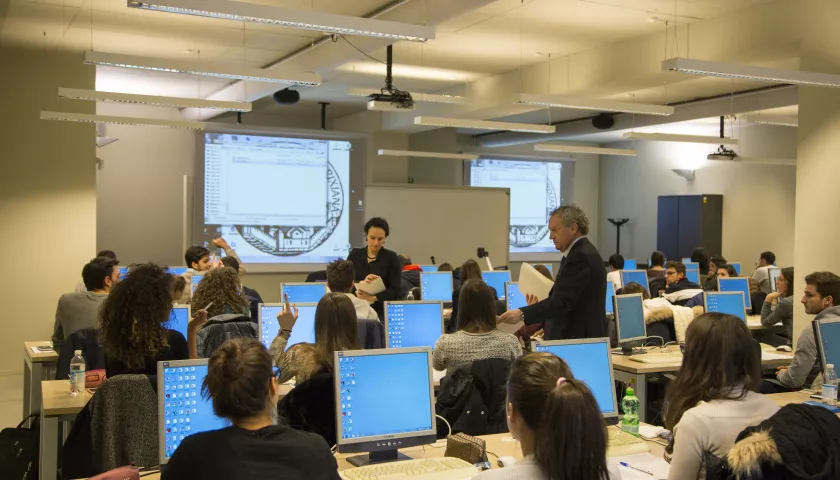
In the second phase, which covers part of the second year and the third year and aims to explore in depth the specific themes of the digital economy and digital business that characterise the degree programme, the following concepts, principles and methods are summarised: empirical economics (SECS-P/05), public and innovation economics (SECS-P/03), financial economics (SECS-P/01); corporate finance (SECS-P/11), innovation and industrial production (SECS-P/08); data analysis, information visualisation technologies and big data (SECS-S/01, SECS-S/03), digital technologies and computational and optimisation methods for decision-making (MAT/09). In this second phase, students also acquire the knowledge and skills necessary to use digital information and communication technologies to support economic and business decision-making: in particular, computer laboratory sessions are held involving the use of statistical and econometric software, as well as optimisation and visualisation software, including open-source options.
The curriculum of the degree programme in Economics and Digital Business is complemented by English language tuition (L-LIN/12), the option for students to include elective modules (12 CFU) in their study plan, work placements (3 CFU), the opportunity to undertake periods of study abroad, and the final examination (4 CFU).
Starting from the academic year 2026-27, only the third year will be active.
It is possible to enrol in the Bachelor's Degree programme in Economics and Data Analysis.
Please consult the page Orientation and selection of the appropriate degree course
You can find all the information at the Graduating Course page.
Student Advisory Service
Student representatives
Degree programme committees
BACHELOR'S DEGREE TEACHING REGULATIONS
The teaching regulations specify the organisational aspects of the Bachelor's Degree, in fullfilment of the freedom of teaching and the rights-duties of teachers and students.
REFERENCES AND CONTACTS
Economics and Law Educational Services
Information on didactic activities
Student Secretariat
Information on enrollments, certifications, and taxes
Student Secretariat
Information on students' careers
Contact the Secretaries’ Office